Qualche volta mi ricordo che prima di essere un appassionato di cucina (molto dilettante) sono un fotografo. Sono quei momenti quando ho in mente una foto che voglio fare e, cascasse il mondo, ci devo riuscire. La foto di oggi è proprio una di quelle. Avevo questi bellissimi fichi "fioroni", cioè i primi fichi che giungono a maturazione, e volevo proprio fotografarli in un ambiente rustico e con un certo tipo di luce. Purtroppo erano già le sette di sera e il mio studio è tutto tranne che rustico, quindi dovevo portare a termine la "commissione" che mi ero assegnato con quello che avevo a disposizione: qualche "prop" (cioè "oggetto di scena"), le mie luci artificiali e una buona dose di immaginazione. Il risultato non sarà proprio uguale a quello che avrei potuto fare se avessi avuto a disposizione un cottage nella campagna inglese ma a mio parere è abbastanza credibile, che ne dite? Potrete leggere la parte culinaria nei prossimi giorni...
Sometimes I remember that, before being a cooking fan (a very amateur one), I am a photographer. Those moments happen when I have clear in my mind a photo I want to shoot, and no matter what, I must succeed. The picture of today is one of those: I bought these beautiful "fioroni" figs, ie the first figs that come to maturity, and wanted to photograph them in a rustic setting and a with certain kind of light. Unfortunately it was already 7 PM and my studio is anything but rustic, so I had to complete my auto assigned "commission" with what I had available: some props, my artificial lights and a good dose of imagination. The result will not be precisely equal to what I could do if I had at disposal a cottage in the English countryside but in my opinion is quite credible, what's your opinion about it? You could read the cooking part in the next days...
E per concludere la "settimana delle ciliege" tiriamo fuori lo champagne per festeggiare con un tocco di classe.
Ingredienti per un drink: 75 ml. cherry brandy, 75 ml. champagne, mezza fetta d'arancio (opzionale).
Preparazione: versate lo cherry ghiacciato in un flute freddo. Riempitelo fino in cima di champagne, anch'esso freddo, e mescolate gentilmente. Se volete guarnite il bicchiere con mezza fetta d'arancio.
To conclude the "cherries week" let's take out some champagne to celebrate with a touch of class.
Ingredients for 1 serving: 2 and 1/2 oz. cherry brandy, 2 and 1/2 oz. champagne, half orange slice (optional).
Preparation: pour the chilled cherry brandy in a chilled flute. Top with champagne, chilled too, and stir gently. If you like you can garnish the flute with half orange slice.
Ingredienti per circa 12 mou: 200 gr. di zucchero di canna, 200 ml. di panna da cucina, 25 gr. di burro, 1 cucchiaio e mezzo di miele, alcune gocce di estratto di vaniglia, sale.
Today we all return children, even though in reality I have never ceased to be one because when I find some of these milky sweets of good quality I pillage them without restraints and concerns about diet. I cannot resist! At this point I thought "but why not try to cook them?" and I tried to find the recipe from my various cookbooks and over the network. I found many, with a lot of differences between them, the following is what gave me the best results and that has the taste that I remember from my childhood.
Ingredients for approximately 12 toffees: 1 and 1/3 cups of cane sugar, 4/5 cup of single cream, 2 tbsp of butter, 1 and 1/2 tbsp of honey, some drops of vanilla extract, salt.
Preparation: put in a pan with a thick bottom the cream and butter with a few drops of vanilla extract and a pinch of salt. Cook it until the liquid has begun to warm and then add sugar and continue to cook on low heat for about 20 minutes while stirring the mixture with a wooden spoon, until it reaches a soft and creamy texture and does not slide down from the spoon. If you want harder toffees just increase the cooking time. Pour the mixture into a baking tin greased with butter, or in a container for ice cubes made of metal, and let it cool for two hours in the refrigerator. When it will be soft but substantial cut the toffess to a squared shape with a knife greased with some butter.
Borlengo: il Re della Montagna - Borlengo: the King of the Mountain
Pochi cibi sono così tradizionali e collegati al proprio territorio come il borlengo. Questo semplice impasto di acqua e farina, la "colla", condito con un po' di lardo e parmigiano, la "cunza", è infatti tipico di solo pochi paesi dell'Appenino fra Bologna e Modena, nonostante le sue origini si perdano nel medioevo: risale infatti al 1266 il primo documento che attesta l'esistenza di questo piatto.
Ingredienti per circa 20 borlenghi: 500 gr. farina tipo 0, 2 litri d'acqua, 1 uovo, mezzo cucchiaio di sale, 150 gr. di lardo, 2 spicchi d'aglio, 1 rametto di rosmarino, 250 gr. di parmigiano reggiano grattuggiato, 1 pezzo di cotica di maiale.
Few foods are so traditional and linked to their own territory as the borlenghi. This simple mixture of water and flour, the "colla" (glue), seasoned with a little of lard and Parmesan cheese, the "cunza" (untranslatable), is typical of only a few towns in the Appenini mountains between Bologna and Modena, despite its origins are lose in the Middle Ages: the first document attesting the existence of this dish dates back to 1266.
Ingredients for approximately 20 servings: 3 and 3/5 cups of all purpose flour, 8 and 1/2 cups of water, 1 egg, half tablespoon of salt, 5 and 3/10 ozs. of lard, 2 cloves of garlic, 1 rosemary sprig, 9 ozs. of gounded Parmesan cheese, one piece of raw pork rind.
Preparation: mince together the lard, garlic and rosemary, warming it up a little in order to mix things up properly. Prepare then the dough for the "colla" by breaking the egg in half the water, slowly adding the flour with a sieve, stirring so to not form lumps. Then add the remaining water and salt while continuing to stir. Take a low, wide pan (the traditional "sole" on which "borlenghi" are cooked are about 40-50 cm wide, choose accordingly), grease its surfece with pork rind and put it over the heat. When it is hot pour a ladle of dough enough to cover it all, but shaking the pan so to make it very thin. Cook both sides until they will detach without efforts from the pan. Then take the "borlengo", season it in the middle with the "cunza" made with lard and sprinkle it generously with Parmesan cheese. Fold it in four as it were a handkerchief and serve hot.
Tacchino in Agrodolce con Ciliege - Sweet and Sour Turkey with Cherries
Continuo la settimana delle ciliege ma però stavolta con un secondo di carne che sfrutta la capacità di questo frutto di accompagnare magnificamente le ricette in agrodolce.
Ingredienti per circa 4 persone: 4 fette di fesa o petto di tacchino, 200 gr. di ciliege snocciolate, 30 gr. di burro, 4 cucchiai di marmellata di ciliege, 3 cucchiai di aceto balsamico, 1 cucchiaino di timo, 3 scalogni, sale, pepe.
I'm continuing the cherries week but this time with a meat recipe that take advantages of the ability of these fruits to go magnificently well with sweet and sour recipes.
Ingredients for approximately 4 persons: 4 turkey steaks (rump or breast), 7 oz. unpitted cherries, 2 tablespoons of butter, 4 tablespoons of cherry jam, 3 tablespoons of aromatic vinegar, one teaspoon of thyme, 3 shallots, salt, pepper.
Preparation: sprinkle the meat with salt and pepper and brown it with the butter in a pan for about two minutes for side. Take it away and keep it at warm. In a saucepan put the juice produced by the meat and the vinegar and then brown into the shallots, finely chopped, and the thyme, adding some water enough so not to burn them. When the sauce will be a bit reduced add the jam and the cherries and cook until it will be enough curdled. Add salt and pepper and put into the meat and let season it for a few minutes on a very low heat.
Piccoli Clafoutis alle Ciliege - Small Cherry Clafoutis
Anche se ieri non ho postato nessuna ricetta non mi sono dimenticato degli impegni presi. Semplicemente domenica, invece di stare a cucinare e fotografare, sono andato su per l'appenino modenese, a Zocca e dintorni, per recuperare la materia prima: dei magnifici duroni di montagna. Per chi già conosce quelli di Vignola sappia che sono ancora meglio e poi i posti sono magnifici, la cucina anche e ci sono delle ricette che vengono fatte solo da quelle parti: infatti ho una sorpresa in serbo per un prossimo post. Ma torniamo alla ricetta di oggi che si basa sul dolce francese della zona del Limousin chiamato clafoutis (sembra dal dialettale "clafir", cioè guarnire, riempire). E' un dolce preparato con diversi tipi di frutta fresca, a seconda della stagione, ma la sua origine sembra proprio legata alla ciliegia e quindi...
Ingredienti per circa 4 persone: 400 gr. di ciliege, 60 gr. farina, 130 ml. di latte, 2 uova, 80 gr. di zucchero, 1 cucchiaio e mezzo di cherry brandy, mezza stecca di vaniglia, cannella in polvere, sale.
Although yesterday I did not post any recipe I didn't forgot my promise. Sundays, instead of cooking and taking pictures, I went to the Appenino Mountains near Modena, Zocca and surroundings, to recover some raw material: magnificent mountain cherries. For those who already know the ones from Vignola, these others are better still and then also the places there are beautiful, the food marvelous and there are also recipes made only in those zones, so I have some surprises in store for a future post. But back to today's recipe: it is based on a cake from the French region of Limousin called clafoutis (it should derive from the dialect "clafir" ie to dress, to fill). It's a cake prepared with different types of fresh fruit, depending on the season, but its origin appears to be related to the wild cherries and then ...
Ingredients for about 4 servings: 9/10 oz. of cherries, 2/5 cup of flour, 1/2 cup of milk, 2 eggs, 2/5 cup of sugar, 1 and 1/2 tablespoons of cherry brandy, half vanilla pod, ground cinnamon, salt.
Preparation: butter four molds of about 4/5 cup of capacity and place at their bottom the cherries without stems but with the pits. Whisk in a bowl the eggs together with 5 and 1/2 tbsp. of sugar until they'll double in volume, add the flour and, continuing to whisk, the warm milk, in whose you have previously cooked half vanilla pod, cherry brandy and a pinch of salt. Pour the mixture over the cherries and bake for 15 minutes at 350 F. When on top of the cakes a small crust will be formed, remove the molds from the oven, sprinkle them with the remaining sugar and the cinnamon and put them back in the oven for another half hour until the clafoutis will look soft and golden and sugar will be caramelized. Serve them still warm.
Ingredienti per un drink: 75 ml. Gin, 20 ml. Vermouth Dry, 3 gocce di angostura, 10 ml. Cherry Brandy, 1 ciliegia maraschino.
Preparazione: mettete nello shaker gli ingredienti assieme a un cubetto di ghiaccio e agitate per bene. Versate in un bicchiere da cocktail guarnito, anche se in realtà è essenziale per il gusto, con una ciliegia maraschino.
As Sunday post here it is another "traditional" recipe, always based on cherries as I promised for this week, but I'm not talking about food but about drinks: the Cherry Martini. This cocktail is one of the infinite variations on the classic Martini theme and I found more than ten different recipes to prepare it. The following one is the more balanced in my opinion because it keeps the taste of Martini adding just the flavor of cherries.
Ingredients for 1 serving: 2 1/2 oz. Gin, 3/5 oz. Dry Vermouth, 3/10 oz. Cherry Brandy, 3 dashes of Angostura Bitters, 1 maraschino cherry.
Preparation: pour all the ingredients together with an ice cube in the shaker. Shake energetically and strain over a Martini glass garnished, but it's essential to the taste, with a red stemmed maraschino cherry.
Ingredienti per circa 4 persone: 500 gr. di ciliege, 500 ml. di panna acida, 1 bacello di vaniglia, 8 gr. (3 fogli) di colla di pesce, 175 gr. di zucchero, vino rosso, un pezzo di cannella, una striscia di scorza d'arancio.
To force you to forgive me for the partial absence of the last few days (why work always concentrates all at the same time?) I propose today another recipe for a dessert using seasonal fruit: cherries. These bright red fruits are a real treat for the eyes as well as for the palate, not to mention that I have just to move from Bologna to Modena and every 100 meters there is a shack where farmers sell them. It's impossible to resist, and in fact I can not resist! Get ready then for a cherries week... but here's to you the first taste!
Ingredients for about 4 servings: 1.1 lb. cherries, 2 and 1/10 cups of crème fraîche, 1 vanilla pod, 3 envelopes of gelatine, 9/10 cup of sugar, 1 glass of red wine, 1 cinnamon quill, a small stripe of orange zest.
Preparation: we start preparing the pudding. Soften the gelatine in cold water for about ten minutes, while you put the crème fraîche together with the vanilla pod and 1/2 cup of sugar to cook at moderate heat until sugar will completely melt. Remove from heat, add the gelatine, after squeezing it well, and pour it all inside some molds that you'll put to rest in refrigerator for several hours. Now the cherries. Pour in a pan a glass of water, a glass of red wine, 2/5 cup of sugar, the cinnamon stick and the orange peel. Put the pan on fire at moderate heat until sugar will melt. Pour into the cherries then and let them cook at very low heat for about an hour. Drain the cherries and, if necessary, stir the liquid on the fire until it becomes syrup. Pour the cherries and their syrup still warm over the puddings, which have to be still cold from the fridge.
Fra la frutta estiva ce ne è una che mi attrae sempre con quel bellissimo colore viola intenso: la prugna. E allora potevo resistere a questa ricetta che ho trovato su Gourmet Traveller? Dopo avere litigato col forno nuovo al secondo tentativo ecco qua questi deliziosi pasticcini fatti dentro delle formine da circa 160 ml. (meglio abbondare con le dimensioni, crescono molto in forno!), buoni sia a colazione che a merenda. E poi sono dietetici, c'è la frutta no? ;)
Ingredienti per circa 12 pasticcini: 350 gr, ricotta di capra, 225 gr. zucchero, 100 gr. farina tipo 0, 90 gr. burro, 100 gr. nocciole, 50 ml. latte, 3 uova, 6 prugne, un cucchiaino di lievito in polvere, la scorza di mezzo arancio.
Preparazione: sbattete 160 gr. di zucchero, 80 gr. di burro e il latte fino a creare una crema omogenea. Aggiungete quindi due uova, una alla volta, sbattendo bene nel mentre. Mescolate dentro la farina setacciandola per bene, quindi aggiungete 80 gr, di nocciole tritate finemente e il lievito. Riempite con l'impasto le formine fino a metà . A questo punto mischiate la ricotta con 40 gr. di zucchero e un rosso d'uovo e versate il tutto in cima alle formine, cospargetele quindi con le restanti nocciole, triturate grossolanamente, e zucchero e in cima per ciascuna metà prugna tagliata finemente a fette. Fate cuocere per circa 20-30 minuti in un forno preriscaldato a 180 gradi e lasciatele raffreddare per circa 5 minuti nelle formine prima di toglierle.
P.S.: vorrei esser bravo come Tartelette a fare i pasticcini... i miei sono bruttissimi da vedere :(
Amidst the summery fruits there is one that really attracts me with its beautiful deep purple color: the plum. Could I resist then to this recipe that I found on Gourmet Traveller? After a short fight with my new oven, at the second try I managed to successfully cook these delicious cakes, made into molds of about 3/4 cup capacity (it's better to abound with the capacity because they grow a lot in the oven), good to be tasted at breakfast or as an afternoon snack. And they are also dietetic, there is fruit inside, isn't it? ;)
Ingredients for about 12 cakes: 1 and 2/5 cup of goat ricotta, 1 cup and 2 tablespoons of sugar, 2/3 cup of plain flour, 3 and 1/5 oz. of butter, 3 and 1/2 oz. hazelnut, 3 and 1/3 tablespoons of milk, 3 eggs, 6 plums, 1 teaspoon of baking powder, finely grated rind of half orange.
Preparation: Beat 4/5 cup of sugar, 2.8 oz. of butter and the milk until you have a homogeneous cream. Add then 2 eggs, one at a time, beating well after each one. Stir into the flour, sieving it in the while, then 2.8 oz. of hazelnut finely minced and the baking powder. Spoon the dough into the molds filling them till about half their size. At this point mix ricotta, 1/5 cup of sugar and 1 egg yolk and spoon the mixture on top of the molds, sprinkle them with the remaining hazelnuts, coarsely chopped, and sugar and upon each mold half a plum thinly sliced. Let them cook in an oven, preheated at 350F, for about 20-30 minutes and then let them cool in their molds for about 5 minutes before removing them.
P.S.: I wish to be as good as Tartelette in cooking cakes... mines are awful to see :(
Ingredienti per un drink: 20 ml. Gin, 20 ml. Apricot Brandy, 20 ml. Calvados.
Preparazione: mettete nello shaker gli ingredienti assieme a un cubetto di ghiaccio e agitate per bene. Versate in un bicchiere da coktail che, se volete, potete guarnire con una ciliegia maraschino.
It is told that this cocktail has been invented in Paris during the First World War, but I think that it could be almost as successful in less tragic moments because it is really tasty as well as beautiful with its golden color. Adding to it that it is renowned as one of the best after-dinner cocktail, I think you really have to learn how to prepare it, so you can easily digest the forthcoming recipes of this blog. And then people says that I don't care of my readers... tsk ;)
Ingredients for 1 serving: 3/4 oz. Gin, 3/4 oz. Apricot Brandy, 3/4 oz. Calvados.
Preparation: pour all the ingredients together with an ice cube in the shaker. Shake energetically and strain over a Martini glass. Optionally you can garnish the cocktail with a red stemmed maraschino cherry.
Ingredienti per circa 4 persone: 2 kg. di cipolle dorate (possibilmente le "gialle" di Medicina), 5 cucchiai di passata di pomodoro, 8 cucchiai di olio, sale, acqua, aceto balsamico.
Although most of the visit to my blog happen during the working week, I think that many people like me love to read in the Sunday morning, and sometimes they also try to find some new idea for the forthcoming lunch. I'll try then, starting this week, to present "Sunday recipes", simple but full of tradition and taste, and as the first one a recipe that is what more "bolognese" you can find, even more than tortellini, that were copied by the cuisines of both Modena and Romagna (with its cappelletti), the "friggione". It's a poor and rural dish, a recipe apparently simple that needs care and some little tricks to be successful and that could be used both as a side dish or a starter, served with toasted bread.
Ingredients for approximately 4 persons: 4 2/5 oz. golden onions, 5 tablespoons of Passata (tomato puree), 8 tablespoons of olive oil, salt, water, aromatic vinegar.
Preparation: slice the onions along their longest side and put them in a large pan together with the oil and a little water. Sear the onions at very very very (did I say very?) low heat for at least two hours, adding some water every now and then because they shouldn't overcook. This is a trick that is usually missing from most recipes but in my experience I never found onions watery enough that didn't need some water added, unless you cook them on a cigarette lighter of course! When onions will become of an uniform pinkish color add salt as you like and the tomato puree, raise then the heat so to condense the food. Serve friggione as a side dish or with toasted croutones adding in this case some dashes of aromatic vinegar.
"Il Quadrilatero" a Bologna è la zona del vecchio mercato mercato medievale che si estende nelle stradine a lato di Piazza Maggiore i cui nomi ancora riflettono le arti e mestieri che vi si svolgevano un tempo (via Drapperie, vie Pescherie Vecchie, via degli Orefici, eccetera). Alcune di queste botteghe risalgano addirittura a quell'epoca e se ne possono vedere la raffigurazione in alcune miniature che corredano gli statuti dell'allora Comune di Bologna.
E' il mio luogo di spesa preferito, qui si può trovare di tutto, fresco, di buona qualità e a tutti i prezzi e, come tutti i punti di ritrovo che hanno una tradizione millenaria, anche oggi è il crocevia di chiunque si trovi a Bologna: vecchie signore emiliane e giovani immigrate, turisti in visita e impiegati in pausa pranzo. Chiunque voglia capire cosa è questa città oggi dovrebbe recarsi qui.
"Il Quadrilatero" in Bologna is the zone of the old medieval market that spreads in the little streets beside the central Piazza Maggiore, and whose present names mirror the arts and crafts that were practised here once: via Drapperie (clothes), vie Pescherie Vecchie (old fishmongers' shops), via degli Orefici (jewellers), etc.
Some of the shops date back to those times and their images could be found in illuminations that illustrate the statutes of the ancient Bologna municipality. It's my preferred shopping place, here you can find anything edible, fresh, of good quality and at all the prices and, just like all the places that have a thousand years long tradition, it's still today the crossroad of anyone who is in Bologna: old ladies and young immigrate girls, visiting tourists and clerks enjoying their lunchbreak. Anyone who wants to understand what is this city today should go there.
The top part of the above table from John Wolf's Vivitar Guide shows the Vivitar Series I lenses available during 1980. We have added in some later Series I lenses from the second series in the early 1990s in the lower part of this chart. Today, you can buy lower cost Series I lenses from a third and more recent tier of lenses at prices little more than standard consumer versions. Most of the professional interest is in the original Series I lineup, with a few of the second design series also being of interest.
The original Vivitar Series I lenses were designed not by a Japanese company or a German optics powerhouse, but by an American company - Opcon Associates (of Stamford Connecticut). Surprise!
Chief Designer E. Betensky had worked with Perkin-Elmer as a senior optical designer. You may recall that Perkin-Elmer also made the original Vivitar Series I solid "cats" mirror lenses too. Thanks to these associations, Opcon Associates was able to use the latest computer technology to explore new and innovative lens designs.
Betensky came up with the idea of changing the air spaces between lens components as the lens focuses more closely. The lenses were made by Kiron, Kino Precision Industries Ltd. of Tokyo to Vivitar (Ponder and Best's) specifications.
So now you know why the original Vivitar Series I lenses were able to offer amazing (for 1972) close focusing for the 135mm f/2.3 (3 feet) and 200mm f/3 (4 feet) that blew away competing optical designs in this area.
Why Does Close-Focusing Matter So Much?
Close focusing matters a lot to both serious amateurs and professional photographers. One of the characteristics of a high quality lens design is a short close-focusing distance. For example, many 500mm telephoto lenses won't focus closer than 50 or 60 feet or more. One that lets you focus significantly closer provides much larger reproduction ratios on film. The early Vivitar Series I lenses were often characterized by a very short close-focusing range, often half that of similar focal length lenses. Some lenses such as the 135mm f2.8 CF is a sleeper in that it looks like a generic low-cost Vivitar lens. But it can focus down to 1:2, just as close as many macro-lenses. . So a zoom optimized for close-focusing work adds some major tricks and benefits to the owner's photographic capabilities.
Vivitar 200mm f/3
One of these faster Vivitar lenses to have cult status now is the 200mm f/3 Series I lens. You can see that this lens sold for $334 in 1974, equivalent to $1,161 in today's 1998 inflated dollarettes. Half a stop slower 200mm lenses sold for a third as much, so this was a pricey lens!
Nearly as fast as a very expensive pro f/2.8 lens, this lens is relatively small (4.6 inches) and compact on the camera. You can hand-hold it nicely, although it is fairly heavy at 29 ounces. But the lens is very sharp and delivers superb results. The f/3 aperture is odd and slightly slower than an f/2.8, but hardly noticeably so even on slide film. Unlike many telephoto lenses, this 200mm will close focus to 4 feet, yielding a 1:4 reproduction ratio on film! Unlike many 200mm f/2.8 telephotos, it also uses smaller standard 72mm filters.
Vivitar 600m f/8 and 800mm f/11 Solid Cats
Vivitar also marketed a series of solid catadioptic or solid cats of one-piece glass construction. These mirror lenses were actually made by Perkin Elmer (of NASA space telescope fame). The 600mm f/8 and 800mm f/11 solid cats have achieved cult status as very compact (only 3.3 inches long), sharp, and super-rugged lenses. Their ruggedness is partially due to their solid, one-piece construction, unlike most current production mirror lenses. This solid one-piece construction design means the elements remain in the optimal fixed positions relative to each other, despite temperature changes or even professional use and abuse.
Weight was only 3 pounds on the 600mm and 800mm lenses! Yet these lenses could close-focus to 23 feet and 25 feet respectively (circa 1:9.3 and 1:8.5 respectively).
One thing to be wary of when buying these lenses is to be sure you get the oddball series filter size filter set, including the UV filter. The lens design requires a filter in the optical path. Be aware that to replace filters, you have to remove the lens, then remove the T-mount, then replace the filter. More modern mirrors have a rotating filter mount.
Most of the standard filters are for black and white photography. Obviously, a polarizing filter would have to be front-mounted, a rather painful financial proposition for such a large filter size. (Hint: Edmund Scientific sells sheets of polaroid material cheaply)
Today, you would be lucky to find these lenses for sale used, as most owners readily appreciate their technical and optical qualities. Few were sold originally because of the steep price tag ($634 in 1975 dollars translates to $1,971 in today's 1998 dollarettes). They quite literally don't make them like this anymore!
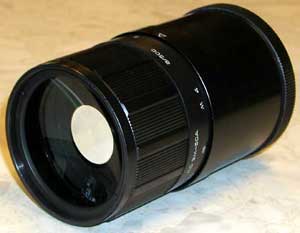
Vivitar 450mm f/4.5 Series I Mirror
This Vivitar 450mm f/4.5 Series I mirror lens is only six inches long and 4 5/8ths inches in diameter. Unfortunately, it takes an expensive and hard to find 97mm filter. Like many Vivitar Series I lenses, the close focusing distance is excellent at a remarkably short 12 feet.
This lens was another failure in the marketplace, and relatively few were sold due almost entirely to the high price (over $770 in 1986, or over $1,100 US today!). The reason for its excellent close-focus performance, and high price, was the unusual use of aspherical plastic elements in its design. But such elements cost ten times what a non-aspheric element costs to manufacture, and that adds quickly to the cost of these lenses.
Vivitar 90-180mm f/4.5 Flat-Field Macro Lens
Vivitar also made a number of high quality zooms under the Series I label. The 90mm to 180mm f4.5 flat-field VMC lens from 1978 is an optic that has also achieved cult status.
This Vivitar 90-180mm f/4.5 lens was really designed for medical photography needs. A ring-light flash unit was designed to mount on the front of this lens too. But as far as I know, it was never released. This original medical market niche explains some of the design features and range of this high quality zoom lens.
This lens is over 6 inches long, and pretty heavy at 2.3 pounds. At a constant f/4.5, you aren't going to value it for its speed either. But it produces excellent results in macro-work down to 1:4 at 90mm and to 1:2 at its 180mm setting.
On most modern zoom lenses, macro photography settings are a lower quality setup. Achieving macro capabilities means shifting some elements and so sacrificing some of the zoom's control over spherical and other aberrations.
Most current zooms only offer macro settings at either one end or the other of their range. Generally, you would prefer macrophotography at the longer end of the range, but most zooms opt for the easier macro settings at the shorter end of the zoom's range. Only a few zooms offer continuous macro-settings over their full range. Even the better current zooms generally only get to 1:4 to 1:6 reproduction ratios (.e., the object is one-fourth lifesize on film).
The Vivitar 90-180mm f/4.5 Series I macro zoom is designed to provide the highest possible quality continuously down to its closest macro settings. The Vivitar 90-180mm f/4.5 flat-field lens provides high quality macrophotography continuously from 90mm (to 1:4) to 180mm (to 1:2). That's unique, and useful, so you should expect to pay quite a price premium for such a cult status lens!
Vivitar Series I 28mm f/1.9
Even today, a 28mm f/1.9 lens would be considered quite fast. This lens provided superb quality, low distortion, and very high speed. Here again, this lens wasn't popular due to its odd f/stop and high price ($305 in 1978). For under half that price, you could buy Vivitar's more compact 28mm f/2 lens. At 12 ounces, this fast f/1.9 lens was also a third heavier than the more compact model. But it was one of the fastest third party lenses ever offered in the 28mm focal length.
Vivitar 135mm f/2.3 Series I
Similarly, Vivitar's Series I 135mm f/2.3 lens ($220 list in 1977) compared very favorably in everything but price with the slightly slower 135mm f/2.5 lens (only $130 in 1976). But the Series I lens offered close focusing to 3 feet (vs. 5 feet for f/2.5) and a reproduction ratio of 1:4.5 versus 1:9 for the slightly slower f/2.5 lens. But that speed and close focusing capability required a 72mm filter on the Series I, versus only 55mm on the f/2.5. For only $60, you could get the TX mount 135mm f/2.8 lens using 52mm size filters. That's a 360%+ premium for circa half a stop of extra speed!
I should mention that there were a few even faster 135mm f/1.8 and even f/1.5 lenses made by Vivitar in 1968, using the preset T-mount. But these lenses were much poorer performers optically than the later Series I 135mm f/2.3 lenses. Avoid them! [
Today, all 135mm lenses are considered out-of-fashion, so you may again be able to get a great buy on a really fast Series I 135mm f/2.3. Two high quality 7 element Vivitar 1.4x and 2x teleconverters can help turn this lens into a still very fast 190mm f/3.2 and 270mm f/4.6 lens. Wow!
Vivitar 24mm f/2
Although this lens is not on our official Series I list, perhaps it should be? This fast 24mm f/2 (and 28mm f/2) can focus as close as 12 inches. The lens takes 55mm filters, weighs only 9 ounces, and is under two inches long. Like the Vivitar 28mm f/1.9 Series I lens, these later lenses also feature internal floating elements for improved close focusing. Except for the later (and related) Kiron 24mm f/2, you have to look at OEM lenses from this period to find the equal to these fast wide angle third party lenses.
Vivitar 135mm f/2.8 CF
Another later entry in our cult classic lens list is this Vivitar 135mm f/2.8 close focusing lens. Surprise! This lens can produce a remarkably close reproduction ratio of 1:2 from a distance of 20 inches! Usually, we think of true macro lenses when we deal with a 1:2 close focusing range, such as the Vivitar 90mm f/2.5 classic described herein.
The lens weighs just over a pound, is 3 3/8ths inch long, and uses 62mm filters. For macrophotography of critters and bugs, this lens is probably a lot cheaper and even more useful than many 100mm range macro lenses. I need hardly add that it is a lot cheaper, when you can find one!
Vivitar Series I 35-85mm f/2.8
This Series I lens provides a wide angle to short telephoto capability in a lens only 3.6 inches long that weighs only 26 ounces. Like its cousins, this Series I lens features a short ten inch close focus range providing a 1:3.5 reproduction ratio. What is more important is that the lens is very sharp throughout this range, with excellent contrast too (thanks to VMC multi-coating). Again, the lens is large in diameter, requiring a 72mm filter, but providing a reasonably fast f/2.8 constant aperture throughout its range.
How could Vivitar provide optimal sharpness with such a zoom in the late 1970s that still holds up to the professional standards of the 1990s? The answer lay in abandoning true zoom action, and substituting a vari-focal zoom. With a vari-focal zoom, you have to re-focus the lens every time you change the focal length. But this trick frees the optical designer to maximize the lens sharpness and quality.
This mechanical dual focusing control complexity puts off many users spoiled by true zooms. Consequently, you can often find this sharp zoom selling for surprisingly low prices (Cf. list $400 in 1978). But as its cult status gets better known, those bargains may be harder and harder to find!
Vivitar 90mm f/2.5 macro
Vivitar came up with yet another cult status great lens, their macro 90mm f/2.5 lens. This optic can reach 1:2 directly, or 1:1 using an accessory closeup lens (supplied). The sharpness and flatness of field leaves little to be desired by even a picky professional user.
Written up by Herbert Keppler in Popular Photography, this lens continues to be very popular on the used market. It didn't hurt that the lens has a street price less than half the cost of similar and even less capable optics. The longer 90mm focal length also provided extra working distance that was lacking in more traditional 50mm and 55mm macro lenses. So if you were looking for a sharp short telephoto macro lens, this lens was the obvious low cost choice. That's enough popularity to justify its cult status in our book!
Vivitar Series I
While the first Vivitar Series I lenses were no-compromise optics, they were disasters in the marketplace. Few lenses sold, partly due to their odd-ball apertures and weight, but mostly due to their high costs. The Series I lenses were generally at least double the cost of very similar aperture and speed lenses already in the Vivitar lineup.
This cheaper Vivitar consumer lens line image also made it hard for photographers to put down these high prices for an off-brand third party lens line. Similar OEM prime and zoom lenses often sold for nearly the same price, sometimes less.
Vivitar learned from the marketplace's rejection of their first Series I lenses. The followup Series I lines were more attune to the marketplace demands. Instead of an 28mm f/1.9 optic, you got standard f/2 optics. Instead of a vari-focal zoom of maximum sharpness, you got a true zoom that was more convenient, but with a bit less refined optical performance. The lenses also became lighter, and more appealing to the consumer mass-market.
The current models labeled Series I lenses are still considerably better optically than Vivitar's own lower to mid-range consumer lens lines. But they are no longer unique nor challenging the OEM lens makers for optical supremacy. Tomorrow's cult classic lenses are more likely to come from Sigma, Tamron, and Tokina....
Vivitar Series I 70-210mm Zooms
1974
31 oz
6 1/8 inch
Kiron
1:2.2
f/3.5
macro button
1982
25 oz
5 5/8 inch
Tokina
1:4
f/3.5
macro
1984
30 oz
5 5/8 inch
Komine
1:2.5
f/2.8-4
macro (beyond 150mm only)
The above table helps highlight some of the changes in Vivitar's most popular Series I mm zoom series. Three different manufacturers made these zooms - Kiron, Tokina, and Komine Co. Ltd. in Japan. A later version of the 70-210mm f/4 (with 1:4 macro) Kiron zoom featured a "zoom lock" switch to prevent zoom slippage [Source: Modern Photography, March 1982, p. 155, Keppler].
The first (Kiron) zoom was arguably an excellent performer in its time. This Series I zoom helped make the fine reputation of these original 1970s Vivitar Series I optics. The second (Tokina made) zoom sacrificed some of the macro capabilities to save weight, while retaining a constant aperture.
The third Series I zoom (by Komine),along with some lens test results, is an improvement over the original Series I (Kiron) zoom. While it is a variable aperture lens, it does offer a much more competitive f/2.8 aperture at the wide end (albeit a slightly slower f/4 at the long 210mm end). The overall lens test results provided by Steve also shows how a decade of design experience has improved the performance of this popular 70-210mm zoom series.
As I have noted in several asides in this page, I am generally leery of older ultra-wide and very wide angle prime lenses and most zooms prior to the mid-1980s. Many others feel the same way, which is why prices on these older lenses are often relatively low. But with a bit of study and research, you can still locate some outstanding optics and at great prices!
In fact, today you can often buy a Series I zoom for little more than the price of the consumer grade zoom. Many of these Series I lenses can be bought for under $100 US on the used market. Vivitar no longer enjoys the reputation for innovation and quality that came with the original Series I line. Yet many of these later 1980s and early 1990s Series I zooms are very capable performers.
Still, a word of warning is in order. Even excellent older optics can be subject to abuse, dropping, shocks, and amateur repair jobs which can compromise their functions. So be sure to carefully test your lenses to ensure that your lens hasn't been abused or mis-aligned!
Similarly, the non-Series I older Vivitar fixed mount lenses were usually only half the price of their Series I cousins. Construction and optical performance was generally good, relative to most consumer grade primes and zooms. These lenses will still perform well today too. But they won't achieve cult status. However, I make an exception for a unique series of Vivitar/Soligor interchangeable lens mount lenses which retained auto-diaphragm action, known as the T4/T5 and TX mounts described below.
Interchangeable T-4 and TX Mount Lenses
To my mind, the T-4 and TX series are more interesting third party lenses, precisely because you can use them on a variety of camera bodies simply by using the appropriate adapter. Consumer quality lenses in the 28mm to 300mm range were no great optical design challenge by the 1980s. So you can expect these lenses to perform reasonably well, although less brilliantly than their Series I cousins, especially when used wide open.
Still, these interchangeable T-4 and TX mount lenses are even less liked by today's consumers, so you can often buy them for as little as $25 US or even less! For $10-15 for a used adapter, you can convert all of these lenses to work on a different camera body (generally non-autofocus models obviously).
In a related case study of Vivitar TX lenses, we discovered that these lenses are full of surprises. For example, their highest ratings for sharpness are wide open rather than the expected middle f/stop settings. Their corner sharpness is generally rated as excellent or very good, while center sharpness varied more widely. The hardest to design 24mm lens was the best rated performer. Surprise! This case study highlights the need to actually test your lenses to learn about these surprising variations.
Summary
In summary, the early Vivitar Series I lenses offered a unique series of fast prime lenses and unusual professional quality zooms. These lenses are still unique today, justifying their cult status.
The later Series I lenses generally rank near the top of third party consumer grade lenses of the same time-frame.
Their mid-range consumer primes and zooms are good or better than average quality consumer grade optics, with a few clunkers mixed in (e.g., those unsharp f/1.5 and f/1.8 135mm telephotos from 1968).
I find Vivitar's out-of-favor T-4 and TX lenses to be more interesting, largely due to the ability to mount them in a multitude of classic cameras bodies I own.
What about the vivitar af 75-200mm lens? I need specs pls??..i am gonna go back in this sight and check it..thanks!
admin
IP:89.133.47.xxx | 2007-08-11 17:00:57
no clue about that sorry
anoni_moose - Vivitarian
IP:65.94.54.xxx | 2008-10-15 17:01:14
The section above related to original Series 1 lenses;the 135mm f2.3 & the 200mm f3.0 is somewhat misleading. Some of the Series 1's where made by Kiron, but not the 135mm f2.3 & the 200mm f3.0. All the examples I've seen have serial numbers starting with #28XXX which makes them made by Komine and not Kiron(I've have the 135mmm).
Screamin Scott - Vivitar 24 & 28mm F2's
IP:69.180.51.xxx | 2008-11-08 05:39:42
Komine also made 24mm F2 & 28mm F2 lenses for Vivitar. I'm assuming the lenses are similar if not identical unless Vivitar changed the specs
Kevin - Vivitar Series 1 105mm Macro C
IP:90.204.171.xxx | 2008-11-29 10:08:53
Hi will this fit any digital cameras as far as you know? There are companies that make mounts I know, but not sure if they will work. Is ther a digital camera (old or new) they might fit? It seems such a shame to waste a good lens like this.
admin - adapter
IP:217.27.219.xxx | 2008-11-29 11:17:43
I suppose your mention Contax/Yashica, adapter available for Canon and Olympus DSLR cameras on Ebay for a few bucks.
Kevin - Vivitar Series 1 105mm Macro
IP:90.204.171.xxx | 2008-12-03 08:13:52
Thanks. I've been told they will fit with an adapter, but most sales assistants in shops shake their heads and say you won't get the sharpness and macro won't be as good. Is this correct, or are they just trying to palm me off to buying a new lens? As I say don't want to waste a good lens. I suppose I could try selling, but have no idea what it would be worth. How well do the adapters on e-bay work?
admin - Sharpness
IP:80.98.161.xxx | 2008-12-08 00:26:55
This is one of the sharpest macro lens include AF lenses too.Don't sell it ,use it instead. Selling price can be vary from 200 USD to 350.
Powered by JoomlaCommentCopyright (C) 2006 Frantisek Hliva. All rights reserved.Homepage: http://cavo.co.nr/